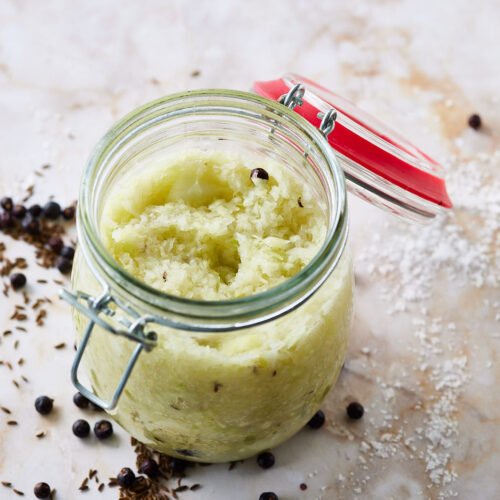
Sauerkraut recipe
Making your own sauerkraut is a fun thing to do and while it does take patience, you really don't need a lot of equipment to make it happen.
Equipment
- 1 large preserving jar (or 2 smaller ones) large enough to hold all the cabbage with some space at the top.
- Mandoline or food processor
Ingredients
Brine
- 350 ml water depending on the size of your cabbage, you may not need all of it
- 10 g sea salt
Sauerkraut
- 1 small white cabbage grated or thinly sliced, weighing approximately 650 g/ 1.4 pounds
- 10 g sea salt use 3 tablespoons of sea salt per kilo of cabbage
- 1 tsp caraway seeds
- 1 tsp juniper berries
Instructions
Brine
- First, make the brine by mixing the (slightly warm) water with the salt until it dissolves. Set aside.
Making sauerkraut
- Remove the outer leaves from the cabbage. Keep 1 leaf to cover the sauerkraut later.
- Make sure everything is clean before you start. This includes the bowl you will use for the white cabbage, the machine, and your preserving jar.
- Cut the cabbage in half and remove the hard core. Then finely chop the cabbage. This is easiest with a mandoline. You can also grate or chop by hand.
- Now divide the cabbage and salt into a bowl. Massage the salt into the cabbage for about 5 minutes. Wait 5 minutes and repeat. Eventually, you will see that the cabbage releases moisture and reduces significantly in volume. Once you see a lot of moisture, your cabbage is basically ready.
- Now mix it with the caraway seeds and juniper berries.
- Place the cabbage in a sterilized preserving jar and press down firmly. The cabbage should be covered with liquid. Top up with brine until there is a layer of liquid on top of the cabbage.
- You can now cover the cabbage with a piece of plastic wrap or use the cabbage leaves. Press down firmly and make sure it doesn't rise. If necessary, weigh it down with something so that it stays pressed down.
- Place in a dark place at room temperature (between 18-20˚C/65-68˚F) for five days. Open the jar every day to allow the gases to escape. In principle, you can eat the cabbage after 5 days, but for best results, leave it for 2-6 weeks.
- Important: Make sure the jar is not too warm or too cold. If it is too cold, it will take too long, and if it is too warm, it may ferment too quickly, resulting in less than optimal results.
- If foam forms on the surface, skim it off.
- The longer you ferment sauerkraut, the more sour it will be. Taste it occasionally to make sure it is to your liking!
Nutrition
Calories: 200kcal | Carbohydrates: 44g | Protein: 10g | Fat: 2g | Saturated Fat: 0.3g | Polyunsaturated Fat: 0.2g | Monounsaturated Fat: 0.3g | Sodium: 7898mg | Potassium: 1242mg | Fiber: 19g | Sugar: 23g | Vitamin A: 707IU | Vitamin C: 262mg | Calcium: 315mg | Iron: 4mg